How Firms Can Profit by Becoming Less Competitive
A short summary of Buchholz, W. and Hattori, K. (2026) “Strategic Self-Handicapping to Induce Rival Mergers”.
Background
Firms usually try to become more competitive by expanding capacity, reaching more customers, and lowering costs. When a business closes a plant or leaves a profitable market, we tend to assume that something has gone wrong.
This paper examines theoretically whether deliberately becoming less competitive can encourage industry consolidation through rival mergers and ultimately increase a firm’s own profit.
It focuses on the actions of a firm that remains outside the merger.
The starting point is a surprising problem with mergers. When rivals merge and reduce their joint output, prices rise and firms outside the merger can expand. That expansion takes business away from the merged firm, potentially making the merger unprofitable for its participants. This is the familiar “merger paradox.”
A firm outside the merger can benefit when its rivals combine. Yet its own ability to expand after the merger may be what prevents the merger from happening. Could giving up some of that ability persuade the rivals to merge? This is the question the paper examines.
What the paper does
The paper develops a theoretical model of three competing firms, two of which may merge. Before they make that decision, the remaining firm can take an action that weakens its own competitive position. The two rivals observe this action and decide whether to merge. Firms then compete by choosing how much to produce and sell.
The key is that the outsider takes an action that cannot easily be reversed, rather than simply promising not to expand. Examples include disposing of production equipment, selling a distribution network, or signing a long-term contract that raises production costs. The rivals’ merger decision will change only if they expect the action to affect subsequent competition.
The paper calls this voluntary acceptance of a competitive disadvantage “self-handicapping.” It first sets out the general mechanism and then studies three examples: reducing capacity, withdrawing from a market, and raising the cost of producing an additional unit. It also considers what happens when the merger makes the rival firms more efficient.
What it finds
First, a firm can increase its profit by weakening itself if doing so makes a rival merger happen.
A capacity restriction, for example, limits how much the outsider can expand after a merger. The rivals then have less reason to worry that cutting their joint output will simply hand customers to the outsider. A merger that would otherwise be unprofitable can become viable.
The firm that reduces capacity may even produce more than it did before the merger. What it gives up is the flexibility to expand still further afterward. Giving up that flexibility makes the merger possible, allowing both its actual output and its profit to rise.
The same idea can apply to a firm operating in two markets. Withdrawing from a profitable market can make a merger more attractive to the rivals left behind. If they merge, the withdrawing firm benefits from weaker competition in the market it continues to serve. That gain can exceed the profit sacrificed in the abandoned market.
The same logic applies to raising costs. In the figure below, the rival merger takes place when the cost of an additional unit reaches about 5, and the outsider’s profit jumps. Raising costs further then reduces its profit. In the baseline model, whenever inducing the merger is worthwhile, the firm chooses the smallest handicap needed to make it happen.
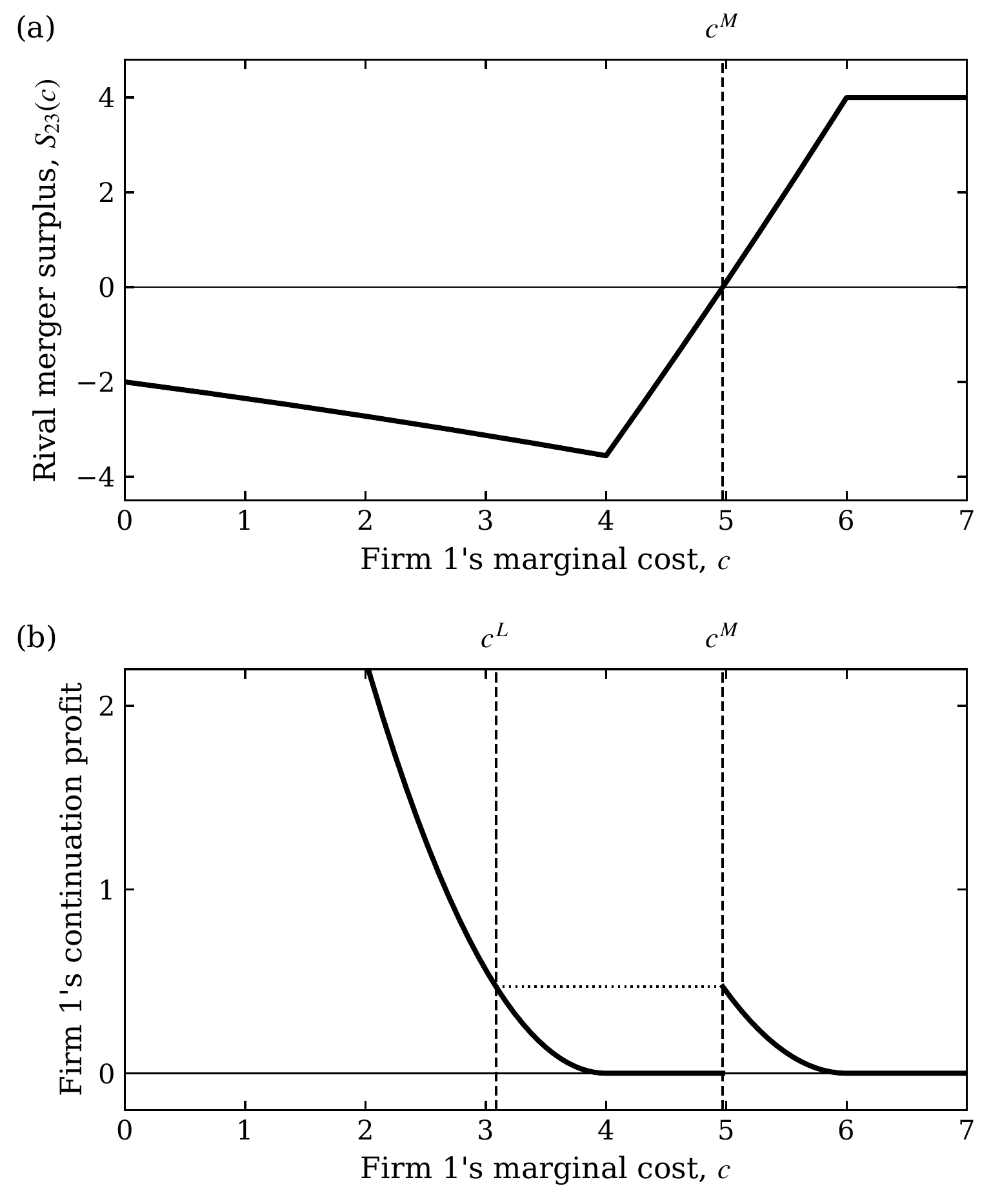
The horizontal axis shows Firm 1’s marginal cost, the cost of an additional unit. The upper panel shows the rivals’ joint profit gain or loss from merging; the lower panel shows Firm 1’s profit, taking the merger decision into account.
Second, efficiency gains from a rival merger can also benefit the firm outside it.
A merged rival with lower costs is a tougher competitor. Yet a more profitable merger also requires less encouragement: the outsider no longer needs to weaken itself as much to induce it. In the cost-increase model, this reduction in the required handicap more than offsets the competitive disadvantage of facing a stronger rival, raising the outsider’s profit from inducing the merger.
Why it matters
The first implication is that actions that weaken a firm’s competitive position need not be mistakes or symptoms of distress. Accepting a disadvantage in the immediate competition can improve the firm’s subsequent environment if it changes the rivals’ decision to merge. Understanding such actions requires looking both at what a firm gains within the current market structure and at how it might change that structure.
For competition policy, the capacities and market presence observed before a merger should not automatically be treated as given. A plant closure or market withdrawal may have been chosen in anticipation of the merger. Would the firm have taken the same action if there had been no prospect of consolidation? That question matters when assessing the merger’s effects.
Higher profits for firms do not necessarily mean gains for society. In the baseline cases without merger efficiencies or productive benefits from the handicap, weaker competition raises prices and reduces both consumer surplus and total surplus. Once an irreversible handicap has been implemented, however, blocking the merger need not restore the earlier competitive conditions. An assessment should therefore consider the merger together with the actions that precede it.
These are theoretical results, rather than evidence that a particular firm closed a plant for this purpose. The paper identifies a mechanism through which such a strategy can work. Becoming more competitive is not the only way to earn more: sometimes, becoming less competitive changes the choices that rivals make.
This research was supported by JSPS KAKENHI Grant Number 24K04912.