Firm Entry under Coopetition
Background
A new competitor is usually unwelcome news for an existing business. More firms compete for the same customers, making it harder for each to earn a profit.
But firms sometimes help cultivate the market in which they compete. Hotels and restaurants promote a tourist destination; producers advertise a product category; businesses contribute to shared infrastructure that attracts customers. In these settings, a new entrant is both an additional rival and an additional contributor to the market’s development.
Entry therefore has two effects: it intensifies competition and helps expand the market.
This combination of cooperation and competition is sometimes called coopetition. How does entry affect existing firms’ profits in such a market? The question also matters for getting an industry started. If firms can operate profitably once enough of them are present, but not when there are only a few, who would be willing to enter first? The paper examines these two questions through a theoretical model.
What the paper does
The paper develops a theoretical model of identical firms that make two decisions in sequence. First, each chooses how much to invest in an activity that expands demand for the whole industry. They then compete by choosing how much to produce and sell.
The investment’s defining feature is that a firm’s spending also benefits its competitors. For example, a hotel that promotes its destination may attract visitors who end up staying at another hotel. Each firm chooses its investment to maximize its own profit, so it also has an incentive to rely on others’ contributions.
It then allows firms to decide whether to enter, taking account of a fixed cost of setting up the business. Finally, it considers how a government, municipality, industry association, or platform could help a viable market get started, either by supporting early entrants or by investing directly in the shared activity.
What it finds
First, entry can increase the profit of every existing firm, even though competition becomes stronger.
Normally, a new entrant takes some customers away from existing firms, reducing their profits. Here, however, the entrant also invests in developing the shared market. If entry leads to enough additional investment in market expansion, the gains from a larger market can outweigh the losses from competing for customers.
These gains do not continue indefinitely. In the case underlying the market-formation analysis, profit first rises with the number of firms and then falls as rivalry eventually dominates.
Second, a market can remain empty even though an active industry would be profitable and benefit consumers.
A prospective entrant considers whether entry would cover its fixed cost, taking other firms’ entry decisions as given. If being the only firm would not be profitable, it stays out. Every other firm can make the same decision. Yet with enough firms already present, their contributions to the shared activity can make the market large enough for all of them to operate profitably.
The result is a low-entry trap: an empty market and a viable active market can coexist under exactly the same underlying conditions. The figure below plots the number of firms on the horizontal axis and profit per firm on the vertical axis. In this example, neither one nor two firms can cover their fixed costs, but three firms can. Further entry remains viable up to seven firms. The difficulty is that the first firms must decide whether to enter before the market has reached the scale needed to support them.
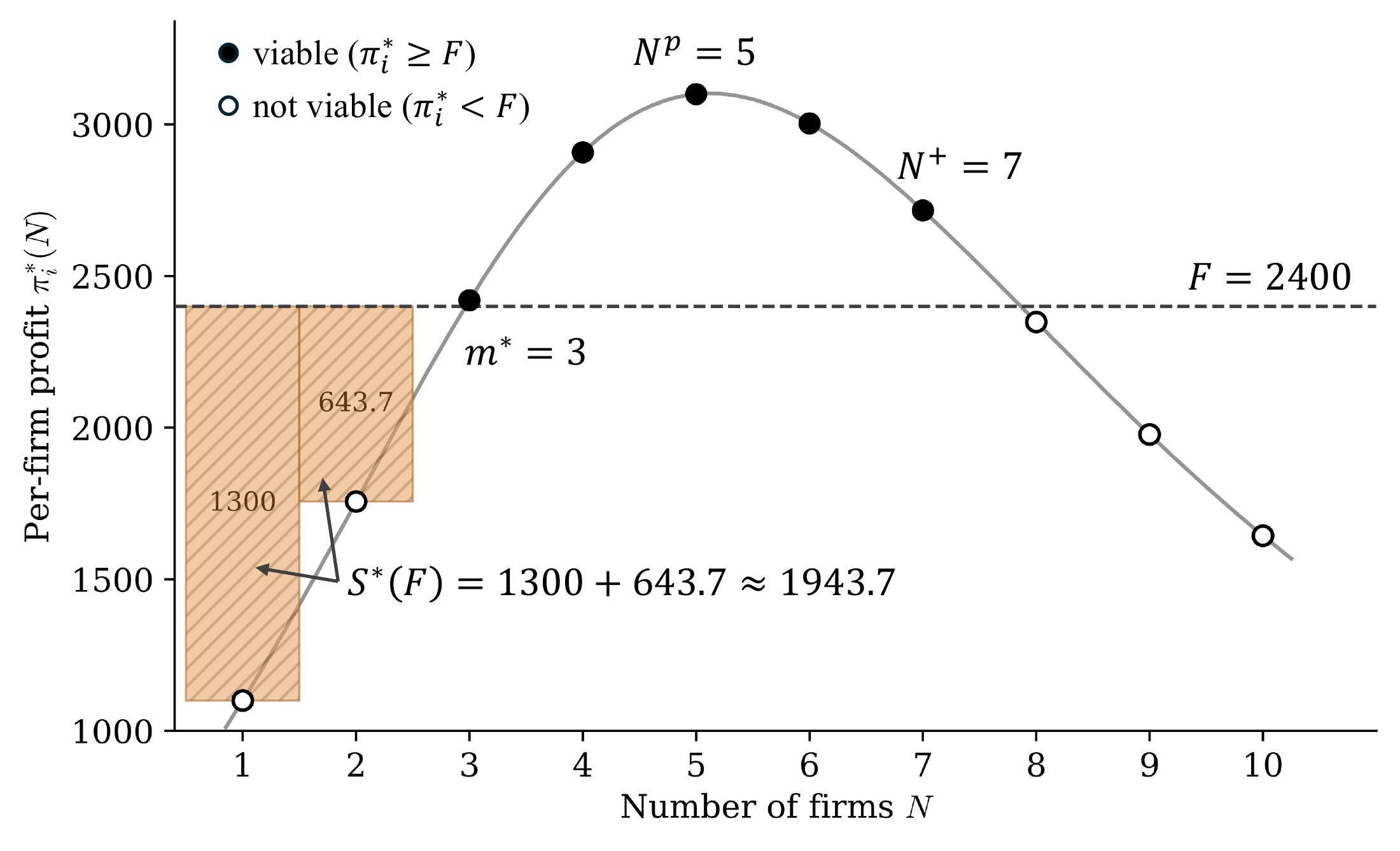
The horizontal axis shows the number of firms; the vertical axis shows profit per firm before the fixed entry cost is deducted. The dashed line marks that cost: a firm is viable when its profit reaches or exceeds the line.
Third, temporary support for the first entrants can be enough to establish a market that subsequently sustains itself.
The paper considers a process in which firms enter one at a time and evaluate profitability at the market size immediately after their own entry. The public sector can cover the shortfalls of the early entrants until the industry reaches its critical mass, the minimum number of firms needed for viability. Subsequent firms can then enter without subsidies, and all firms are viable once entry stops.
In the figure above, only the first two entrants need transitional support. The shaded areas show the subsidies needed at these first two entry steps. The third firm can enter without support, and the market can grow to seven firms.
Fourth, supporting the shared market directly can be an alternative to subsidizing individual firms.
For example, a public works project that provides shared infrastructure to attract customers can make entry more profitable and reduce the number of firms needed for viability. With enough investment, even the first entrant becomes viable. The paper assumes that the infrastructure continues to provide benefits once it has been built. At a given number of firms, such public investment also encourages firms’ own investment in expanding demand.
Which approach costs the public sector less depends on how efficiently it can provide the shared infrastructure. When only the first entrant is unviable and it is already close to breaking even, a small investment can be especially attractive.
Why it matters
The first implication is that a lack of entry need not mean that there is no viable market. Businesses that cannot operate profitably when only a few firms are present may succeed once enough firms help develop the shared demand on which they depend. Destination development, commercial districts, and platform launches provide settings in which this distinction may matter.
This also changes how we interpret support for new industries. The relevant question is whether initial support can establish a group of firms that will subsequently be viable. The model identifies a role for assistance concentrated on the early stages of market formation. It does not imply that any unprofitable industry can become self-sustaining if it receives enough temporary support.
For policy design, the public sector’s budget and society’s gains require separate assessments. Under the paper’s assumption that financing raises no additional economic distortions, entry subsidies transfer purchasing power from taxpayers to firms. Shared infrastructure uses real resources, such as labor and materials. Its cost must therefore be weighed against the benefits it creates. Yet because it also expands demand and can sustain a larger market, direct investment can deliver greater social gains even when it costs the public sector more than subsidies.
These are theoretical results, rather than direct empirical findings about particular industries. The welfare analysis treats shared investment as creating genuine value for consumers. Within that setting, the paper shows how firms’ dual role as competitors and contributors can explain both why a market is worth creating and why it may fail to get started.
This research was supported by a FY2026 research grant from the Kampo Foundation and JSPS KAKENHI Grant Number 24K04912.
About the paper
- Title: Profit-Increasing Entry and the Low-Entry Trap under Coopetition
- Authors: Keisuke Hattori and Takeshi Yoshikawa
- Year: 2026
- Publication status: Working paper, available on EconStor
- Full paper: https://hdl.handle.net/10419/343408